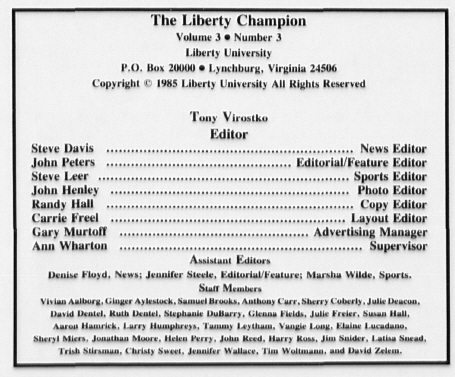
Time BA (Before “Anthony”)
From the Liberty University Digital Commons… The Liberty Champion from when I was on the staff as Feature Editor and as Editor-in-Chief. (Yes, at that time I was known by the name before I came out.)

Time BA (Before “Anthony”)
From the Liberty University Digital Commons… The Liberty Champion from when I was on the staff as Feature Editor and as Editor-in-Chief. (Yes, at that time I was known by the name before I came out.)
Posted in Journalism
I found this listing of animal group names useful for writing just the right word to describe groups. The imagery associated with some of these terms helps to build thorough descriptions, simply, without relying on the trite or mundane. The fine balancing act comes in pacing and use, of course. As a writer knowing the right word versus “the almost right word” makes all the difference.
For a complete list of animal names, including young and groups, the Wikipedia List of animal names includes male/female, collective noun, collateral adjective, and “trivial” name. Sometimes a cow is a cow.
Maybe, I should change the first name of my ExNihilo antagonist to “Jenny” since she can really be an ass.
Sometimes, the tech writer part of me comes out when I find information sites like these. But, I think attention to details makes for writing right. For example, during a recent review of ExNhilo my proofreader asked about something I wrote about the placement of a piano and organ in a church sanctuary. I’ve always understood the information to be accurate for placement, but I can’t remember I got the information. Of course, now I can “Google it,” but even that didn’t present definitive results. So, I’m still searching for the “correct placement of an organ” in a church. Now, if Wikipedia would list that!
Posted in Musings
Literary Fiction, @60K
In a mid-life crisis, a gay artist’s health concerns provoke fears of failure as he battles to determine his life’s worth.
“Can I move my junk?” I asked, nodding toward my barely paper-covered crotch.
“Your junk?” She laughed and smiled. “Sure.” She pressed a button, and the metal plank where I was prone rose.
I returned the smile, nervously, reaching under the paper to lift and separate my junk away from the dark, unkempt nether region rebelling against me and the cause of my precarious planked position. Later, I realized it didn’t really matter. The radiation spray was gonna get everything within a certain spread. That spread included my manhood. My junk.
I didn’t normally refer to it as my junk, but I felt hipper using the term. Wasn’t that what the kids called male genitalia nowadays? It doesn’t make sense to me, since my manhood is my prized possession. And to have it under the gun – a huge, rotating arm of a gun shooting invisible bullets of radiation – doesn’t endear the term to me.
Junk adjusted and position set, the technician scurried from the room to hide behind the leaded safety walls. Red lights blinked. The colossus swung to life, rotating counterclockwise until the head stopped just beyond my peripheral vision. I felt its arm there, I just couldn’t see it.
I counted every setting. Every click. Every whirl of the machine. Nine total stops. Two whirls at each stop.
Stories and servings from the Historic Kenwood Garden Workshop
Associate Editor, Writer
Fund-raising cookbook

Associate Editor, Writer
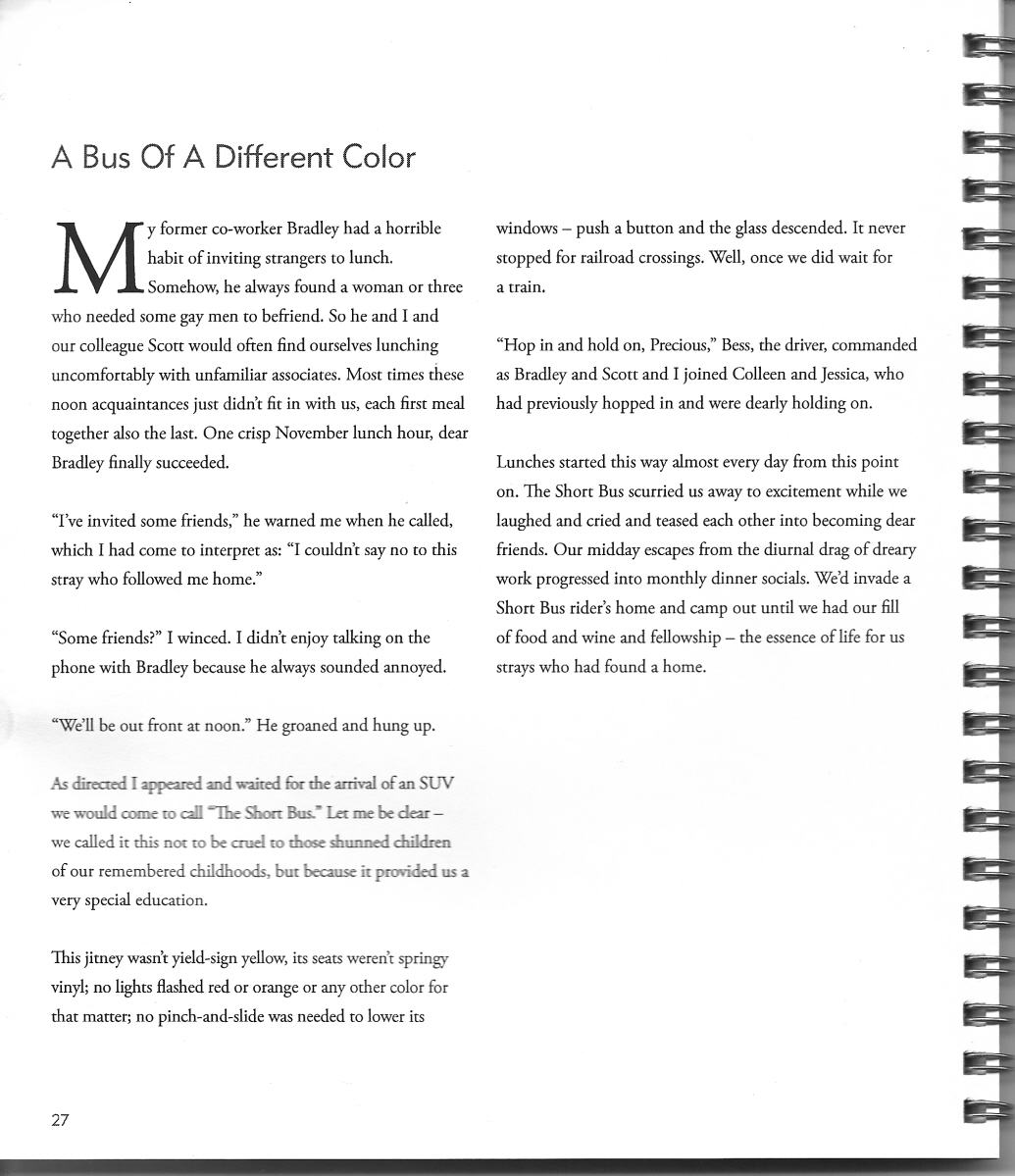
From Digin
Interesting development I found over at IBM:
The IBM Watson Personality Insights service uses linguistic analytics to extract a spectrum of cognitive and social characteristics from the text data that a person generates through blogs, tweets, forum posts, and more.
Test runs of different pieces of my writing provided different outcomes, of course. For example pieces from fiction produced the protagonist personality, which fits. For my own blog post writing, it did reflect closer to my own personality type.
I wonder if some sci-fi story has been written about how nobody speaks in the future, because the computer hears your words and determines your actions… I guess it’s like a “precog” from Minority Report but instead of mutants, it’s computer. Of course Orwell’s 1984 even involved something similar with constant surveillance. Maybe it’s because the open-ended: “and more” in the description leaves the uses wide open.
Because of my non-fiction book: The Four Sisters Groove: Learning the steps to effective communication, I have a special interest in anything dealing with personality and the interaction of those personality types. According to the IBM Watson site, The Personality Insight Model analytics are built on the Big Five, Needs, and Values models. Of course how IBM Watson did all this is described at the site, but when it comes to writing right, the idea of content reflecting personality and decision-making outcomes opens up a huge opportunity for writing. From fiction to non-fiction, how could this influence your ability to write right?
Does your character say and do the things that fall in line with his “Big Five” or “Needs” or “Values?” Does knowing this about your writing help your characters to “ring true?” Give it a run on your writing and see how right it rings.
For writing right, the morning holds a special place. The freshness of the mind following a good night’s sleep helps release the creative juices. Julia Cameron encourages Morning Pages, and I agree. Writing Rituals from some writers are interesting to read about. 
As a journalist in my formative years, I learned to write anything, anywhere, at any time. My journalism teachers drilled it into our heads, and once I was writing out in the “real world,” it developed into the “normal” way to write.
Once I started to switch from the reporter to the novelist, I found the morning writing ritual was right for me. I would go to work and write fiction at my desk for an hour or more before anyone else arrived.
Ritual implies “a series of actions performed according to a prescribed order,” and I can attest to writing as ritual, whether it is “anywhere and any time” or habitual morning activity. A writer writes.
Learning the steps for effective communication is like learning to dance.
Non-fiction, 80K
Dance like no one is watching,
love like you’ve never been hurt,
sing like no one is listening,
and live like it’s heaven on earth.
— Anonymous
Saturday night and Hunter wants to dance. He cranks up his screaming diva and wiggles his little butt to a beat he thinks he hears, but isn’t really there. The poor boy has no rhythm. He’s thump-thump challenged.
Or maybe you’ve slid on your cowboy heels and headed down to the watering hole and watched Liz and Sheila two-stepping and wondered how they did it so smoothly. It seemed as if every muscle, every sinew moved perfectly timed.
When you think about it, relationships and dancing have a lot in common: for instance, they both require hard work to get right, and they both can be terribly painful when they go wrong.
Some people do have a slight natural edge over others, yet it takes practice to really hone those moves. An expert is someone who has worked so hard it appears easy to do. Most everyone knows good relationships require open communication. As much as we’d like these skills alone to dramatically and instantaneously improve relationships, we know relationships are a complex web of expectations, needs, and interpersonal skills. However, an improvement in one area can make other aspects of the relationship easier to manage.
The object is not to make other people change, but an interesting thing happens when you make small changes – behavior changes that make it easier for others to relate to you: Over time, the accumulation of temporary and situational changes improves the relationship in subtle, lasting ways.
So the dance becomes smoother, like every move is perfectly timed, because practice makes perfect.
Introduction
Sisters’ Quiz
a. Katie
b. Stacey
c. Gina
d. Tina
Dance Floor
a. Prink Placement
b. Sashay Scale
c. Observing
d. Listening
Grooving
a. Sisters in the Groove
b. Fear and Love
c. Crunks
d. Sketchanese
Dance Cards
a. Introduction
b. Instructions
c. Card copies
d. Follow through
Literary Fiction, 60K
To keep his college scholarship, a preacher’s kid must make it through a summer missionary trip without anyone learning his secret.
He passed the hay field on his way. It wasn’t much of a field — maybe a few acres. He had worked the field once during a summer he spent walking behind a hay wagon, lifting bound bails of weeds and alfalfa and heaving them into place. With little effort he learned the “hay kick” — the knee lift used to move the 100-pound bails. He had a choice of positions. Drive the truck, stack or heave. Newcomers were usually the younger guys, so they had to heave first. Adam was heaving.
No one really worked there for the money — nor for the worn holes in the knees of their jeans, the sunburned noses or sore muscles. No one liked the farmer. It never meant intelligent dissertations or even nice conversation. It seldom meant anything more than simple, back-alley gutter talk. In fact, they looked on anything else with disdain and disgust — as though some great sin had been committed. Males from all walks of life worked there, but any resemblance to status in town dropped behind the hay wagon. You accomplished your rise in the hay field ladder by hardy laughs, foul language and simple hard work. And the status didn’t pass unnoticed. Those tenured hands eagerly accepted their positions of influence. It was their duty — part of their role.
Sometimes the heat of the afternoon sun baking a Midwestern hay field proved too much, and they said nothing. They walked silently beside the hay wagon, quickly hoisted the dry, dusty bails. No breezes evaporated the sweat during those stifling days. A saturated shirt grasped chest and back, clinging greedily, trying to suck more moisture. Once finished, they gathered at the farm cooler — a spigot sticking out of the ground. A backyard treasure — the highlight of the workday — tapped into the cool waters seeping out of the well deep below them. Once again the talk would rise. No matter the names called or the number of bails heaved — all had been forgotten. Faces were rinsed and necks sprayed. Bits and pieces of dried grass got swished from cracked lips. Tobacco chunks were removed and renewed. All returned to normal around the spigot. The field foreman called the newest crew member a pecker head, and the favor was returned with crueler language.
Along with locker rooms and possibly backyard basketball courts, the hay fields yielded the closest form of male bonding known in town. The stubby grass fields offered complete release from normal living constraints. They said anything. Discussed everything. Used all the dirty names they knew and even ones they made up. Belches and burps abounded. No genital parts were spared the wrath and humor of the witty field foreman. They worked, but no paycheck equaled the complete and utter pleasure. Later, when the youthful men aged into solitary figures lost in a crazy world, memories would drift to those pleasures shared working on the hay fields.
Links:
When I host a Groove session, I make it a point to first talk about the Groove Philosophy. This is the basic premise behind why I have Four Sisters Groove and the means to function within that framework. It is the boundaries and “Dance Floor” of another type, if you will. So I thought it would be a good thing to discuss as we begin the New Year together.
With this core philosophy in place, the Four Sisters Groove provides a working session for learning effective communication skills that is safe, confidential and fabulous. Let me know if you would like to host or join a Groove Session.